
| SEO Title | Stellite 6 vs Stellite 12: What Is the Difference? |
| Meta Description | Compare Stellite 6 and Stellite 12 for hardfacing. Learn the key differences in hardness, wear resistance and toughness, and which service conditions suit each grade. |
| Suggested Slug | cobalt-alloy-6-vs-12 |
| Primary Keyword | Cobalt Alloy 6 vs 12 |
| Secondary Keywords | Cobalt Alloy 6; Cobalt Alloy 12; ERCoCr-A; ERCoCr-B; cobalt alloy welding rod; cobalt hardfacing |
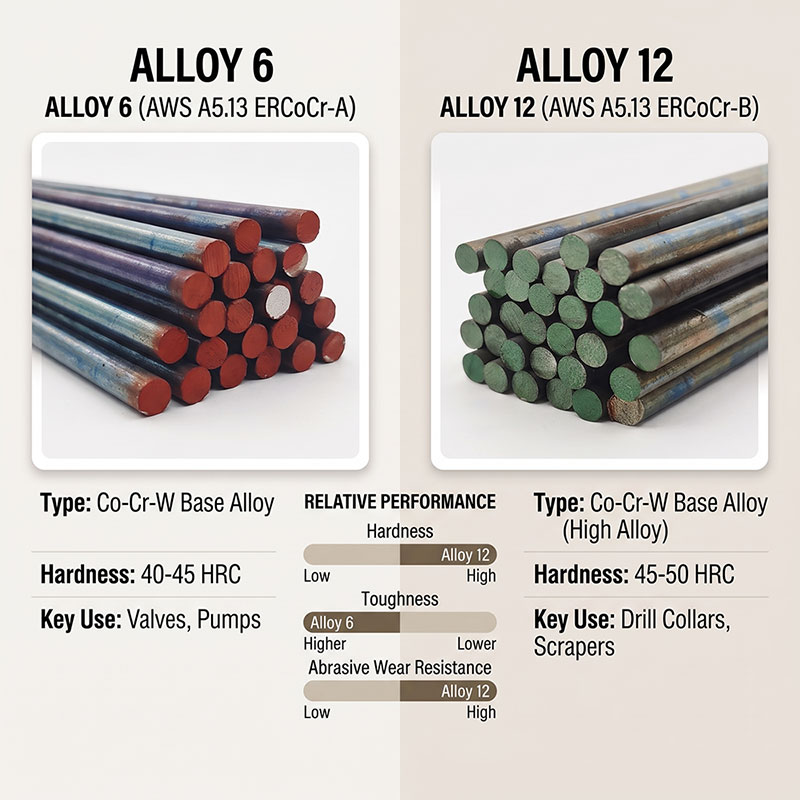
Cobalt Alloy 6 and Cobalt Alloy 12 bare rods are both widely used for hardfacing in industries. The main difference is not that one is simply “better” than the other. They have different balances of hardness, wear resistance, and toughness.
Cobalt Alloy 6 is the more commonly used grade. Cobalt Alloy 12 contains more hard carbide phases, has higher hardness and better resistance to abrasive wear, but with lower toughness than Alloy 6.
Cobalt Alloy 6 vs 12: The Core Difference
| Property | Cobalt Alloy 6 | Cobalt Alloy 12 |
| AWS A5.21 Standard | ERCoCr-A | ERCoCr-B |
| Hardness | HRC 43 | HRC 47 |
| Metal-to-Metal Wear | Excellent | Excellent |
| Toughness | Higher | Lower than Alloy 6 |
The difference mainly comes from chemistry. Alloy 12 contains more carbon and tungsten than Alloy 6, which increases the amount of hard carbides in the alloy structure.
More carbides mean a harder working surface and stronger resistance to abrasion. At the same time, the material becomes less tolerant of impact and more difficult to machine.
This is why the difference between Alloy 6 and Alloy 12 should be understood as a change in property balance, rather than a simple increase in performance.
When Is Cobalt Alloy 6 More Suitable?
Cobalt Alloy 6 is generally better suited to applications where the working surface experiences mixed wear conditions rather than severe abrasion alone.
It combines good resistance to sliding wear and galling with better toughness than Alloy 12. This makes it useful where metal surfaces repeatedly contact each other or where some impact and thermal cycling are also present.
- Valve seats and sealing surfaces
- Pump wear surfaces
- Engine valve hardfacing
For many general industrial hardfacing applications, Cobalt Alloy 6 is used because it does not rely on maximum hardness alone. It provides a more balanced combination of wear resistance and toughness.
When Is Cobalt Alloy 12 More Suitable?
Cobalt Alloy 12 is better suited to applications where abrasion and surface wear are more severe and higher hardness is more important than impact resistance.
Its higher carbide content helps the deposited surface resist abrasive particles, sliding contact and edge wear more effectively than Alloy 6.
- Saw teeth and saw-related hardfacing
- Valve surfaces exposed to stronger abrasive wear
Cobalt Alloy 12 is therefore often selected when Alloy 6 does not provide enough abrasion resistance, but the application does not require the toughness of Alloy 6.
Need Cobalt Alloy 6 or Cobalt Alloy 12 Welding Rods?
Shenyang Confident Trading Co., Ltd. specializes in cobalt alloy welding consumables for industrial hardfacing applications.
If you already know the grade you need, fill in the inquiry form on this page with your product form, size and quantity. If you are comparing Alloy 6 and Alloy 12 for an application, tell us the working conditions and we can help you review the requirement.
Email: marking@sytop.cn
WhatsApp: +86 130 0924 9727